
Products

LT Power Supply Cable
LT Control Cable
LT Railway Signalling Cables
LT Submersible Cable
LT Flexible & Cord Cables
LT Multistrand Flexible Cables
LT Telephone and LAN Cables
LT Aerial Bunch Cables
LT Co-Axial Cable
LT Special Purposes Cables
Instrumental Cables
Solar Cables
All Aluminium Alloy Stranded Conductors
Aluminium Conductors Steel - Reinforced (ACSR)
Contact Form
✉ Enquiry Form

Blog &
Industry Insights
Latest updates from cable technology and electrical industry.
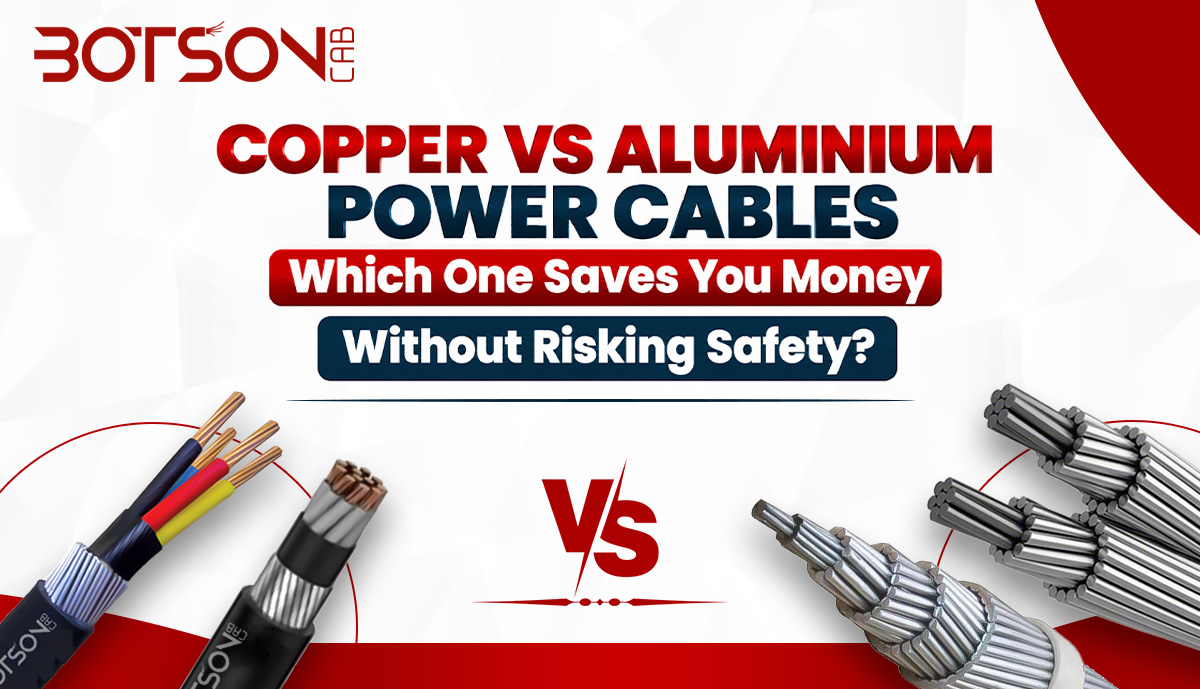
COPPER VS. ALUMINUM POWER CABLES: WHICH ONE SAVES YOU MONEY WITHOUT RISKING SAFETY?
Industrial Wiring
28-09-2026
Choosing between copper and aluminum power cables is one of the most consequential decisions in any electrical installation — and one of the most frequently oversimplified. Procurement teams often reduce the choice to a single line item: cost per metre. Design engineers know better. The real comparison involves conductor sizing, termination behavior, thermal performance, and the operating life of the installation itself. Get it right, and aluminum can deliver substantial savings without compromising safety. Get it wrong, and the "cheaper" option becomes the more expensive one within a year.
This guide breaks down where each material earns its place, so the decision is based on engineering fit rather than price alone.
Conductivity and Sizing: The Starting Point
Copper has significantly higher electrical conductivity than aluminum — roughly 60% higher for a conductor of the same cross-sectional area. In practical terms, this means an aluminum cable must be sized larger than a copper cable to carry the same current safely. For many installations this is a manageable trade-off. For others — particularly where conduit space, panel capacity, or duct sizing is fixed — it becomes a genuine constraint.
This is why the "cost per metre" comparison is incomplete. A fair comparison has to account for the larger aluminum conductor needed to match copper's ampacity, along with the larger conduit, glands, and lugs that go with it. Once sizing is corrected for equivalent current-carrying capacity, the price gap between the two materials narrows considerably.
Where Aluminum Cable Delivers Genuine Value
Aluminum is not a lesser substitute for copper — it is the correct engineering choice in several well-defined scenarios:
1. Long-distance, high-current runs -
For feeder cables, overhead distribution lines, and utility-scale power transmission, aluminum's lower weight reduces the load on supporting structures and simplifies installation logistics. Over long runs, this weight advantage compounds into meaningful cost and labor savings.
2. Stable, predictable loads
Installations with steady current draw and minimal thermal cycling — as opposed to frequent start-stop loads — put less stress on aluminum's terminations, which is where most aluminum-related failures originate.
3. Budget-constrained infrastructure projects
For large-scale industrial and infrastructure work where cable runs extend into kilometers, aluminum's lower raw material cost delivers savings that are difficult to match with copper, even after accounting for larger conductor sizing.
The deciding factor in nearly every successful aluminum installation is not the material itself but the quality of the conductor and the standard of termination practice. Aluminum expands and contracts more than copper across thermal cycles, which means connections that are not torqued and maintained to specification will loosen over time — producing resistance, heat, and eventually failure. This is a workmanship and material-quality issue, not an inherent flaw in aluminum as a conductor.
Sourcing from established aluminum wire manufacturers in India that follow IS-specified purity and insulation standards materially reduces this risk. Conductor consistency, surface treatment, and insulation quality vary significantly across suppliers, and this variance is precisely where long-term reliability is won or lost.
Where Copper Cable Is the Right Specification
Copper's higher conductivity and mechanical stability make it the specified choice in several categories of installation:
1. Space-constrained wiring.
Panel wiring, control rooms, and building interiors often have fixed conduit and duct sizing. Copper's smaller footprint for equivalent ampacity makes it the practical — sometimes the only viable — option.
2. Variable and cyclical loads
Motors, compressors, and industrial machinery with frequent start-stop cycles place repeated thermal and mechanical stress on terminations. Copper's stability under these conditions results in fewer maintenance interventions over the cable's service life.
3. Safety-critical and code-mandated applications
Hospitals, data centers, high-rise buildings, and installations governed by specific wiring regulations frequently mandate copper, where the incremental material cost is small relative to the operational risk of a termination failure.
4. Low-maintenance requirements
Installations that are difficult or costly to inspect and re-torque periodically benefit from copper's long-term connection stability, reducing the total cost of ownership even though the upfront material cost is higher.
This is why reputable LT copper cable manufacturers in India place heavy emphasis on conductor purity, insulation resistance testing, and consistent manufacturing tolerances — copper is typically specified precisely where failure carries the highest consequence, and quality variance is least tolerable.
Calculating the True Cost, Not Just the Purchase Price
A complete cost comparison includes four variables, not one:
Material and conductor sizing cost
Aluminum's raw material advantage, offset partially by larger required conductor size
Installation and termination labor —
Aluminum often requires more skilled, careful termination work to avoid long-term connection issues
Maintenance and inspection cost over the installation's service life
copper generally requires less frequent intervention
Failure and downtime risk
The cost of a tripped line, a damaged junction box, or an unplanned shutdown, which rarely appears on the original quotation
For long-distance, stable-load infrastructure, aluminum typically remains the lower total-cost option even after factoring in all four variables. For internal building wiring, variable-load machinery connections, and safety-critical systems, copper's higher upfront cost is usually recovered through reduced maintenance and a longer trouble-free service life.
Making the Right Specification Decision
The correct choice depends on three factors specific to the installation: the length and route of the cable run, the nature of the electrical load, and the environment in which terminations will operate over the cable's lifetime. Neither material is universally superior — each is engineered for different conditions, and the cost of getting the specification wrong is rarely visible until months after commissioning.
At Botsoncab, we manufacture both aluminum and LT Control cables to IS-specified standards, and our technical team works directly with contractors and procurement teams to match conductor material, sizing, and construction to the actual demands of the installation — not simply the lowest quoted price. If you're evaluating copper versus aluminum for an upcoming project, a brief technical consultation before finalizing the order can prevent a far costlier correction later.
Conclusion
Copper and aluminum are not competing for the same job — they are engineered solutions for different sets of conditions. Aluminum earns its place in long-distance, high-current, stable-load installations where weight and raw material economics drive real savings. Copper earns its place wherever space is limited, loads fluctuate, terminations are hard to inspect, or the cost of failure is simply too high to risk. The expensive mistake isn't choosing one material over the other — it's choosing either one without matching it to the run length, load profile, and termination conditions of the actual installation.
The cable itself is rarely where budgets go wrong. It's the mismatch between material and application, or a compromise on conductor quality to hit a lower price point, that turns a "cost-saving" decision into a rework bill. At Botsoncab, we manufacture both aluminum and LT copper cables to IS-specified standards, and our technical team is available to help you specify the right conductor for your project before the order is placed.
Frequently Asked Questions
1. Is aluminum cable actually cheaper than copper cable in the long run?
It depends on the application. For long-distance, stable-load installations such as feeder lines and infrastructure projects, aluminum typically remains cheaper even after accounting for larger conductor sizing. For space-constrained or variable-load installations, the maintenance and termination costs associated with aluminum can offset its lower purchase price over time.
2. Why do aluminum cable terminations fail more often than copper?
Aluminum expands and contracts more than copper across thermal cycles. If connections are not torqued and maintained to the correct specification during installation, they can loosen over time, leading to resistance, heat buildup, and eventual failure. This is largely a termination and quality issue rather than an inherent flaw in aluminum as a conductor material.
3. Can I use the same cable size for aluminum and copper?
No. Aluminum has roughly 60% lower conductivity than copper, so an aluminum cable needs a larger cross-sectional area to safely carry the same current as a copper cable. Sizing must be adjusted accordingly to maintain equivalent ampacity.
4. Which cable is better for industrial machinery with frequent start-stop cycles?
Copper is generally the better choice for variable, cyclical loads such as motors and compressors, since it handles repeated thermal and mechanical stress with greater long-term connection stability than aluminum.
5. Are all aluminum and copper cables the same quality regardless of manufacturer?
No. Conductor purity, insulation quality, and manufacturing tolerances vary significantly between suppliers. Sourcing from established, IS-certified manufacturers materially reduces the risk of premature failure, regardless of which metal is chosen.

Ready to get started?
Subscribe to our Newsletter
Stay connected with the latest trends and updates in the cables and wires industry.

Stay connected with the latest updates, innovations, and offers from BotsonCab. Join our newsletter to receive exclusive content, industry insights, and more directly to your inbox.
OFFICIAL INFO
Botsoncab , TYCON INDIA LLP D-11, Site-1, Bulandshahr Road Industrial Area, Ghaziabad, Uttar Pradesh- 201009
info@botsoncab.com
hr@botsoncab.com
+91-87961 03013
COPYRIGHTS © 2025-26 ALL RIGHTS RESERVED. POWERED BY BOTSONCAB
Developed and Maintained By Blue Brain Technologies Pvt. Ltd.