
Products

LT Power Supply Cable
LT Control Cable
LT Railway Signalling Cables
LT Submersible Cable
LT Flexible & Cord Cables
LT Multistrand Flexible Cables
LT Telephone and LAN Cables
LT Aerial Bunch Cables
LT Co-Axial Cable
LT Special Purposes Cables
Instrumental Cables
Solar Cables
All Aluminium Alloy Stranded Conductors
Aluminium Conductors Steel - Reinforced (ACSR)
Contact Form
✉ Enquiry Form
Blog &
Industry Insights
Latest updates from cable technology and electrical industry.
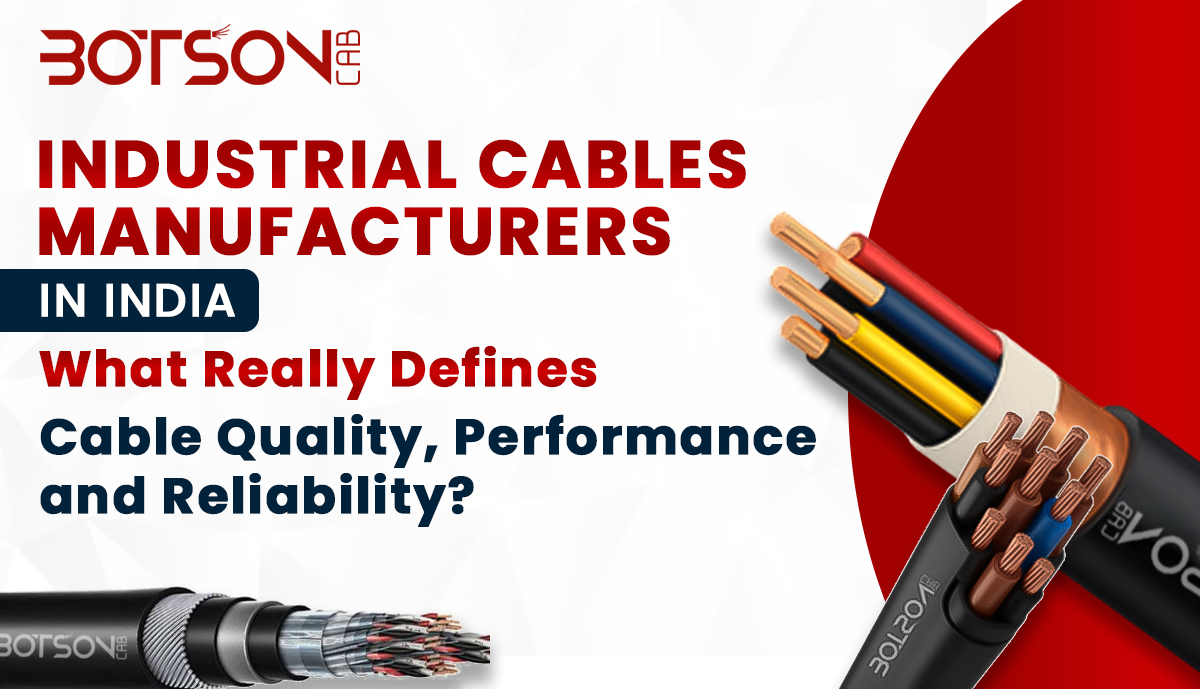
INDUSTRIAL CABLES MANUFACTURERS IN INDIA: WHAT REALLY DEFINES CABLE QUALITY, PERFORMANCE AND RELIABILITY?
Installation Guide
29-08-2026
When an industrial cable is installed, most of its important qualities are no longer visible. The conductor is inside the insulation, the insulation is protected by the sheath, and the complete cable may run through a machine, plant, panel, underground route or industrial installation for years. That is why choosing industrial cables manufacturers in India should not be based only on price, appearance or a product catalogue. The real difference lies in the materials used, manufacturing controls, cable construction, testing and whether the finished cable is suitable for its intended working conditions.
For industrial buyers, cable quality is ultimately about one thing: reliable electrical performance over the expected service life.
What Makes an Industrial Cable Different?
Industrial installations can expose cables to conditions that ordinary wiring may not face. Depending on the application, cables may need to handle continuous electrical loads, temperature variations, mechanical stress, moisture, chemicals, vibration or demanding installation environments.
A suitable industrial cable therefore needs more than a good conductor. Its complete construction has to work together.
The key areas include:
- Conductor material and construction
- Insulation quality
- Inner and outer sheath
- Cable configuration
- Mechanical strength
- Temperature performance
- Electrical characteristics
- Applicable standards and testing
This is where the capabilities of industrial cable manufacturers in India become important.
1. Conductor Quality Is Only the Starting Point
Copper and aluminium are widely used as electrical conductors, but simply specifying the material does not tell the complete story. The conductor's cross-sectional area, stranding, flexibility, electrical resistance and manufacturing consistency all influence cable performance.
For industrial applications, the conductor must provide the required current-carrying capability while maintaining acceptable electrical losses under operating conditions. A manufacturer needs proper control over conductor processing so that the finished cable consistently meets its specified dimensions and electrical characteristics.
2. Insulation Determines More Than Electrical Safety
The insulation separates the conductor from other conductive elements and from the surrounding environment. Its job is not simply to prevent electrical contact. The insulation material needs to be appropriate for the cable's operating voltage, temperature and application.
Depending on the requirement, industrial cables may use insulation systems such as PVC, HR, FR or FRLS. For example, flame-retardant or low-smoke characteristics can be important in installations where fire behaviour and smoke generation are major considerations. Poor insulation quality can affect electrical reliability, especially when a cable operates continuously under demanding conditions.
3. Sheathing Protects the Cable From Its Environment
An industrial cable can spend years exposed to its surroundings. The outer sheath therefore plays a major role in protecting the internal construction.
The appropriate sheath depends on where and how the cable will be installed.
Industrial cable applications may require protection against:
- Moisture
- Abrasion
- Mechanical handling
- Temperature
- Environmental exposure
- Chemical or industrial conditions
PVC and other suitable sheath compounds can be selected according to the application.
A cable designed correctly for its installation environment is far less likely to suffer premature deterioration.
4. Cable Construction Affects Long-Term Performance
Two cables can have similar voltage and conductor specifications but still differ considerably in construction.
Core arrangement, insulation thickness, fillers, inner sheath, armour and outer sheath all contribute to the finished cable.
For applications requiring additional mechanical protection, armoured construction may be appropriate. Depending on the cable design, armour can use materials such as galvanised steel wire, steel strip or aluminium-based options.
The important point is that cable construction should match the installation requirement rather than being selected only from a price comparison.
5. Manufacturing Consistency Matters
A technically correct cable specification means little if production is inconsistent.
This is one of the most important areas to evaluate when comparing industrial cables manufacturers in India.
A reliable manufacturing process should maintain control over critical stages, including conductor preparation, insulation extrusion, core identification, cabling, sheathing and final finishing.
Dimensional consistency is also important. Variations in insulation or sheath thickness can affect the finished cable's performance and compliance with its intended specification.
For industrial buyers purchasing cables in quantity, consistency from one production batch to another is just as important as the specification itself.
6. Testing Provides Evidence of Quality
Quality should not depend on appearance.
Testing gives manufacturers and buyers measurable evidence that a cable meets its required characteristics.
Depending on cable type and applicable requirements, testing can involve electrical, dimensional, mechanical and other relevant performance checks.
Common considerations include:
- Conductor resistance
- Insulation resistance
- High-voltage testing
- Dimensional checks
- Physical properties of insulation and sheath
- Flame-related characteristics where applicable
The exact tests depend on the cable design, applicable standard and intended application.
For buyers, asking about testing procedures and documentation is far more useful than judging cable quality by its outer appearance.
7. Standards Help Define the Expected Performance
Industrial cables are manufactured against specified technical requirements. Standards establish parameters relating to construction, dimensions, materials, electrical properties and testing.
For example, certain PVC insulated cables may be manufactured according to applicable Indian Standards (IS), depending on the cable category.
However, mentioning a standard on a product specification is not enough. The manufacturer must have suitable processes and testing practices to consistently produce cables against the relevant requirements.
This is an important part of evaluating any industrial cables manufacturer in India.
8. Application Should Decide the Cable
There is no single industrial cable that is ideal for every installation.
A cable used for power distribution has different requirements from a control cable, instrumentation cable, railway signalling cable or flexible cable.
Before selecting a product, buyers should consider:
- Operating voltage
- Current/load requirement
- Number of cores
- Conductor material
- Installation method
- Operating temperature
- Mechanical exposure
- Environmental conditions
- Required insulation and sheath properties
- Applicable standards
This application-first approach helps prevent the common mistake of selecting a cable simply because its basic specification looks suitable.
Botsoncab: Manufacturing Cables With Application in Mind
Established in 2020, Botsoncab manufactures a range of wires and cables for electrical, industrial and infrastructure requirements.
Its product range includes LT Power Supply Cables, LT Control Cables, LT Flexible & Cord Cables, LT Multistrand Flexible Cables, LT Railway Signalling Cables, LT Aerial Bunch Cables, LT Co-Axial Cables, Instrumental Cables, Solar Cables and other specialised cable solutions.
The focus is on maintaining consistency across material selection, cable construction, manufacturing and quality checks so that products can meet the requirements of their intended applications.
For industrial projects, this approach matters because the right cable is not simply a product with the correct label. It is a product whose materials, construction and tested characteristics are appropriate for the conditions in which it will operate.
What Should Industrial Buyers Ask Manufacturers?
Before finalising an industrial cable supplier, ask practical technical questions rather than focusing only on quotation price.
A buyer should be able to understand:
- What conductor material and construction are being used?
- Which insulation and sheath materials are specified?
- What standard applies to the particular cable?
- What testing is carried out during and after manufacturing?
- Is the cable suitable for the actual installation environment?
- What technical documentation is available with the product?
These questions help turn cable purchasing from a price comparison into a proper technical evaluation.
Conclusion
The quality of an industrial cable is built into its entire construction. Conductor quality, insulation, sheathing, manufacturing consistency, testing and application suitability all contribute to its final performance and service life.
When evaluating industrial cables manufacturers in India, buyers should therefore look beyond the catalogue and quotation. The more important question is whether the manufacturer has the technical capability and manufacturing discipline to produce a cable that performs consistently in its intended environment.
For Botsoncab, reliable cable manufacturing starts with understanding these requirements and maintaining quality throughout the manufacturing process—not simply at the final stage.
FAQs
1. What are industrial cables used for?
Industrial cables are used for power distribution, control systems, instrumentation, machinery, infrastructure and other demanding electrical installations.
2. How do I choose an industrial cable manufacturer in India?
Evaluate the manufacturer's product range, manufacturing capabilities, applicable standards, testing procedures, technical documentation and ability to supply cables suited to your specific application.
3. Does conductor material affect industrial cable performance?
Yes. Conductor material, cross-sectional area, resistance and construction directly influence electrical performance and current-carrying capability.
4. Why is cable insulation important?
Insulation provides electrical separation and helps the cable operate safely within its specified voltage and temperature conditions.
5. What makes Botsoncab different as an industrial cable manufacturer?
Botsoncab focuses on manufacturing wires and cables with attention to material selection, construction, manufacturing consistency and quality requirements for electrical and industrial applications.

Ready to get started?
Subscribe to our Newsletter
Stay connected with the latest trends and updates in the cables and wires industry.

Stay connected with the latest updates, innovations, and offers from BotsonCab. Join our newsletter to receive exclusive content, industry insights, and more directly to your inbox.
OFFICIAL INFO
Botsoncab , TYCON INDIA LLP D-11, Site-1, Bulandshahr Road Industrial Area, Ghaziabad, Uttar Pradesh- 201009
info@botsoncab.com
hr@botsoncab.com
+91-87961 03013
COPYRIGHTS © 2025-26 ALL RIGHTS RESERVED. POWERED BY BOTSONCAB
Developed and Maintained By Blue Brain Technologies Pvt. Ltd.