
Products

LT Power Supply Cable
LT Control Cable
LT Railway Signalling Cables
LT Submersible Cable
LT Flexible & Cord Cables
LT Multistrand Flexible Cables
LT Telephone and LAN Cables
LT Aerial Bunch Cables
LT Co-Axial Cable
LT Special Purposes Cables
Instrumental Cables
Solar Cables
All Aluminium Alloy Stranded Conductors
Aluminium Conductors Steel - Reinforced (ACSR)
Contact Form
✉ Enquiry Form

Blog &
Industry Insights
Latest updates from cable technology and electrical industry.
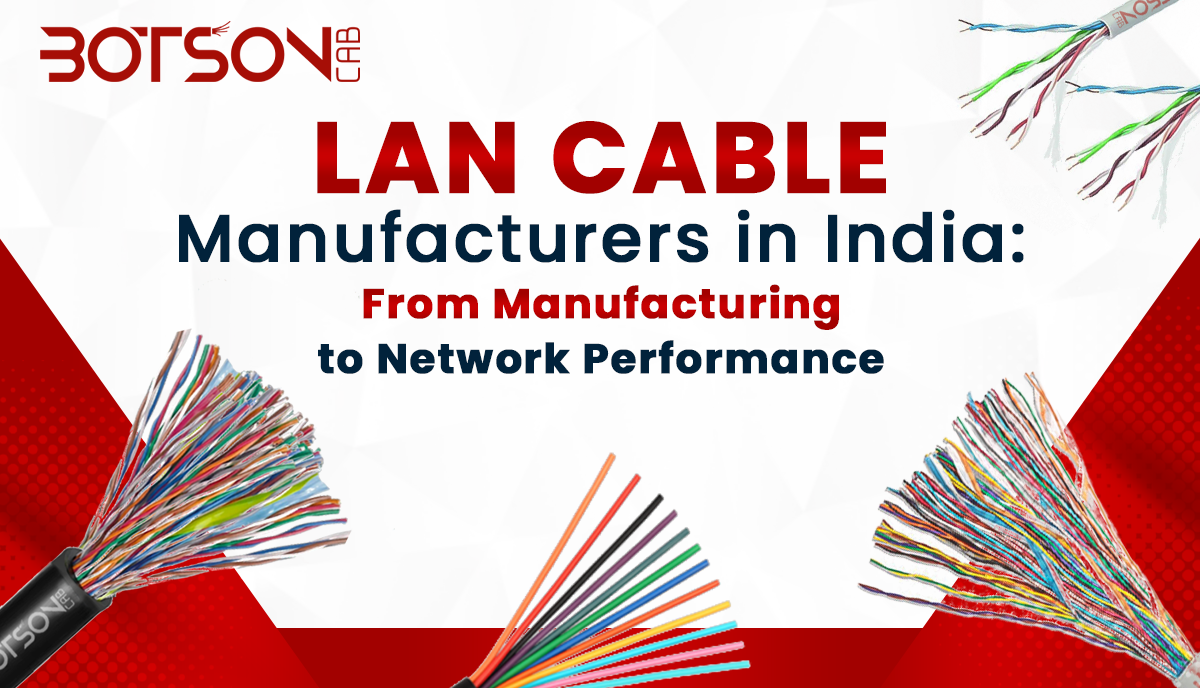
LAN CABLE MANUFACTURERS IN INDIA: MANUFACTURING, SPECIFICATIONS & BUYING GUIDE
Cable Technology
14-09-2026
When a LAN cable works properly, most users never think about it. Data moves between computers, switches, routers, servers and other network devices without interruption. But when the cable is poorly manufactured, problems such as unstable connections, packet loss, reduced transmission performance and frequent network downtime can appear.
This is why choosing the right LAN cable manufacturers in India is not simply about comparing prices. The manufacturing process, conductor material, insulation, cable construction, testing and application suitability all influence how reliably a LAN cable performs after installation.
For businesses, offices, data infrastructure, industrial networks and structured cabling projects, understanding what happens between LAN cable manufacturing and actual network performance can make the purchasing decision much easier.
What are LAN Cables ?
LAN (Local Area Network) cables are network cables used to connect computers, routers, switches, servers, and other devices within a local network. They enable data transmission and reliable network connectivity in homes, offices, commercial buildings, and industrial environments.
Common LAN cables include Ethernet cables such as Cat5e, Cat6, and Cat6A, which are designed for different data speeds and networking requirements. For businesses looking for reliable networking solutions, LAN Cable Manufacturers supply cables in different specifications, constructions, and lengths to suit various installation needs.
Types of LAN Cables
LAN cables are available in different categories and constructions depending on network speed, bandwidth, installation environment, and application requirements. The most commonly used Ethernet LAN cables include:
1. Cat5e (Category 5e): Suitable for standard office, home, CCTV, and general networking applications. It supports Gigabit Ethernet over typical network runs.
2. Cat6 (Category 6): Offers higher bandwidth and improved performance compared with Cat5e. It is commonly used in offices, commercial buildings, data networks, and structured cabling installations.
3. Cat6A (Category 6A): Designed for higher-performance network infrastructure and supports 10 Gigabit Ethernet over standard channel lengths. It is commonly considered for data centres, enterprise networks, and infrastructure projects.
4. Shielded LAN Cables: Available in constructions such as FTP, STP, or other shielded designs, these cables are used where additional protection against electromagnetic interference is required.
5. Unshielded LAN Cables (UTP): A widely used option for offices, homes, commercial buildings, and general structured cabling where excessive electromagnetic interference is not a major concern.
Applications of LAN Cables
LAN cables are used wherever devices need a stable wired network connection and reliable data transmission. Common applications include:
1. Homes & Residential Buildings – Connecting computers, smart TVs, routers, and other network-enabled devices.
2. Offices & Corporate Networks – Connecting computers, printers, switches, servers, and other IT equipment.
3. Schools & Educational Institutions – Supporting computer labs, network infrastructure, and internet connectivity.
4. Data Centers – Connecting servers, switches, storage systems, and other networking equipment
5. Commercial Buildings – Used for structured network cabling across offices, retail spaces, and business facilities.
6. Industrial Facilities – Supporting communication between computers, networking equipment, automation systems, and monitoring devices.
7. CCTV & IP Surveillance Systems – Used with compatible IP cameras and network equipment for data transmission.
8. Telecommunication & Networking Infrastructure – Connecting various network devices within local-area networks.
For businesses requiring dependable networking infrastructure, LAN Cable Manufacturers in India provide cables in different categories and specifications based on network speed, installation environment, and application requirements.
Specifications of LAN Cables
1. Category: Cat5e, Cat6, Cat6A, etc.
2. Conductor: Copper
3. Pairs: 4 twisted pairs / 8 conductors
4. Impedance: Typically 100 Ω
5. Shielding: UTP, FTP, STP, etc.
6. Insulation: PE/HDPE
7. Sheath: PVC or LSZH
8. Frequency: Depends on cable category
9. Application: High-speed data transmission and network connectivity.
What Makes a LAN Cable Suitable for Reliable Network Connectivity?
A LAN cable is more than a group of conductors covered with an outer jacket. Its construction has to support consistent electrical performance while protecting the internal components during installation and use.
A reliable LAN cable generally depends on:
- Conductor quality and consistency
- Correct conductor dimensions
- Insulation quality
- Pair construction and twisting consistency
- Separation between pairs
- Protection against external interference
- Proper outer sheath construction
- Dimensional consistency during manufacturing
- Electrical and physical testing
Small variations during manufacturing can affect the cable's performance. For this reason, buyers should evaluate the manufacturer and manufacturing controls, rather than judging a LAN cable only by its appearance or quoted price.
How LAN Cables Are Manufactured in India
Understanding the basic manufacturing process helps buyers know what they are actually paying for when selecting a LAN cable manufacturer.
1. Conductor Selection
The conductor forms the electrical path through which signals travel. The material and dimensional consistency of the conductor are therefore important considerations.
Depending on the cable design and application, manufacturers work with specified conductor materials and sizes. Consistency in the conductor helps maintain predictable electrical characteristics throughout the cable length. For buyers, an important question is not simply "Is this a LAN cable?" but: What conductor construction does the manufacturer use, and is it suitable for the intended network application?
2. Insulation of Individual Conductors
Each conductor needs appropriate insulation to prevent unwanted electrical interaction between conductors. The insulation material must maintain its properties during manufacturing, installation and normal operating conditions. Uniform insulation thickness is also important because inconsistent construction can affect the cable's electrical characteristics.
3. Pair Formation and Twisting
LAN cables contain pairs of conductors that are twisted together. The twisting arrangement is a critical part of LAN cable construction because it helps control interference between signal pairs and contributes to the cable's transmission performance. This is one area where manufacturing precision matters significantly. The geometry of the pairs should remain consistent throughout the cable.
4. Cable Assembly
The individual pairs are assembled into the complete cable according to the manufacturer's specified construction. At this stage, maintaining the correct relationship between the pairs is important. Poor construction can affect electrical performance and make the cable more difficult to terminate correctly.
5. Outer Sheathing
The assembled cable receives an outer protective sheath. The sheath protects the internal construction from mechanical damage, handling and environmental exposure appropriate to the cable's intended application. For projects involving extensive cable installation, sheath quality can also influence how easily the cable can be handled, routed and installed.
6. Testing and Quality Inspection
Manufacturing should not end when the outer sheath is applied. Quality-focused LAN cable manufacturers in India use inspection and testing procedures to verify that the finished cable meets the required specifications. Depending on the cable type and applicable requirements, testing may cover electrical, dimensional, mechanical and physical characteristics.
Why Manufacturing Quality Directly Affects Network Performance
The connection between manufacturing quality and network performance is often overlooked. A network may contain high-quality switches, routers and computers, but the physical cabling still forms an essential part of the communication path.
A cable with inconsistent construction can contribute to:
- Unstable network connections
- Transmission errors
- Reduced performance
- Signal interference
- Difficulties during termination
- Premature cable failure
- Additional maintenance requirements
This does not mean that every network problem originates from the cable. Network configuration, connectors, patch panels, active equipment and installation practices also matter. However, using properly manufactured cabling removes one major source of uncertainty from the physical network infrastructure.
What Should Buyers Check Before Choosing LAN Cable Manufacturers in India?
If you are purchasing LAN cables for an office, commercial building, industrial facility or structured cabling project, consider these factors before placing an order.
1. Manufacturer's Product Specifications
Ask for clear technical specifications rather than relying only on statements such as "high quality" or "high speed."
Check:
- Cable category
- Conductor material
- Conductor size
- Cable construction
- Insulation material
- Sheath material
- Available lengths
- Application suitability
- Applicable standards or test requirements
A credible manufacturer should be able to explain the construction of its cable in understandable technical terms.
2. Manufacturing Capability
A manufacturer should have appropriate production and quality-control processes for maintaining consistency from one production batch to another. For bulk procurement, this becomes particularly important. A cable that performs well in one batch should not be treated as acceptable if subsequent batches have substantially different construction or specifications.
3. Quality-Control and Testing Practices
Ask what quality checks are performed on the finished cable. Documentation such as test reports, technical datasheets and applicable compliance information can help procurement teams evaluate a product more objectively.
4. Application Requirements
The right LAN cable depends on where and how it will be used. An office network may have different requirements from an industrial environment. Similarly, a short internal installation may have different considerations from a large structured cabling project. Before selecting a product, consider: Where will the cable be installed, how long will the cable runs be, what network equipment will be connected, and what environmental conditions will the cable experience?
5. Consistency in Bulk Supply
For contractors and project buyers, consistency can be just as important as the initial sample. If hundreds or thousands of metres of cable are required, the manufacturer should be capable of supplying the required quantity with consistent specifications and manufacturing quality.
Botsoncab: Focusing on Wires and Cables for Electrical Connectivity
Botsoncab is an Indian wire and cables manufacturer in India for different electrical and connectivity requirements. The company works across a range of cable products, with attention to manufacturing specifications, product construction and quality requirements.
For buyers evaluating LAN cables, the important consideration is not only the product name but whether the cable's construction and specifications are appropriate for the intended network application. Botsoncab can be considered by businesses, contractors, distributors and project buyers looking for an Indian cable manufacturer for their requirements.
How Manufacturing Quality and Installation Work Together
Choosing a reliable manufacturer is only one part of building a dependable network.
The final network performance also depends on:
Manufacturer → Cable quality → Installation → Termination → Network equipment → Testing
A properly manufactured cable can still experience problems if it is badly terminated or physically damaged. Likewise, excellent installation practices cannot completely compensate for a cable that does not meet the required specifications.
The strongest approach is therefore to control the entire physical-layer process—from product selection to installation and testing.
Conclusion
Choosing among LAN cable manufacturers in India should go beyond comparing quotations or judging a cable by its outer appearance. The manufacturing process—from conductor selection and insulation to pair formation, sheathing and testing—has a direct role in producing consistent cable performance.
For buyers, the better approach is to evaluate technical specifications, manufacturing capability, quality-control practices, documentation, application suitability and supply consistency before making a purchase.
For businesses and project teams considering LAN cable procurement, Botsoncab provides an Indian manufacturing option for wire and cable requirements, with product selection based on the specific application and technical requirements. Need LAN cables for your next project? Contact Botsoncab to discuss your cable requirements and product specifications.
Frequently Asked Questions
1. Who are LAN cable manufacturers in India?
LAN cable manufacturers in India are companies involved in producing network cables used for data communication and connectivity applications. Their capabilities may include conductor processing, insulation, pair formation, cable assembly, sheathing, testing and quality inspection.
2. What should I check before choosing a LAN cable manufacturer?
Check the cable category, conductor construction, insulation, pair design, sheath, applicable specifications, quality-control procedures, testing documentation and the manufacturer's ability to maintain consistent production quality.
3. Does LAN cable manufacturing quality affect network performance?
Yes. Consistency in conductor construction, insulation, pair geometry and overall cable design can influence electrical performance and signal transmission. Installation and termination quality also play an important role.
4. Is the cheapest LAN cable always the best option?
No. Price should be compared with specifications, manufacturing quality, testing, expected service requirements and application suitability.
5. Can LAN cables be used for industrial networks?
LAN cables can be used in industrial networking applications when the selected cable is appropriate for the environment and network requirements. Factors such as mechanical conditions, electromagnetic interference and installation environment should be considered.
Looking for LAN Cables for a Project?
The right cable starts with the right specification.
If you are sourcing LAN Cables for an office, commercial building, industrial installation, infrastructure project or bulk requirement, share your application, required construction, quantity and delivery requirements with BotsonCab. The technical team can discuss the appropriate cable requirements and available product options.
BotsonCab
Address - D-11, Site-1, Bulandshahr Road Industrial Area, Ghaziabad, Uttar Pradesh – 201009
Email: info@botsoncab.com
Phone: +91-8796103013
For product enquiries and quotations, buyers can contact BotsonCab directly through its enquiry channel.

Ready to get started?
Subscribe to our Newsletter
Stay connected with the latest trends and updates in the cables and wires industry.

Stay connected with the latest updates, innovations, and offers from BotsonCab. Join our newsletter to receive exclusive content, industry insights, and more directly to your inbox.
OFFICIAL INFO
Botsoncab , TYCON INDIA LLP D-11, Site-1, Bulandshahr Road Industrial Area, Ghaziabad, Uttar Pradesh- 201009
info@botsoncab.com
hr@botsoncab.com
+91-87961 03013
COPYRIGHTS © 2025-26 ALL RIGHTS RESERVED. POWERED BY BOTSONCAB
Developed and Maintained By Blue Brain Technologies Pvt. Ltd.