
Products

LT Power Supply Cable
LT Control Cable
LT Railway Signalling Cables
LT Submersible Cable
LT Flexible & Cord Cables
LT Multistrand Flexible Cables
LT Telephone and LAN Cables
LT Aerial Bunch Cables
LT Co-Axial Cable
LT Special Purposes Cables
Instrumental Cables
Solar Cables
All Aluminium Alloy Stranded Conductors
Aluminium Conductors Steel - Reinforced (ACSR)
Contact Form
✉ Enquiry Form

Blog &
Industry Insights
Latest updates from cable technology and electrical industry.
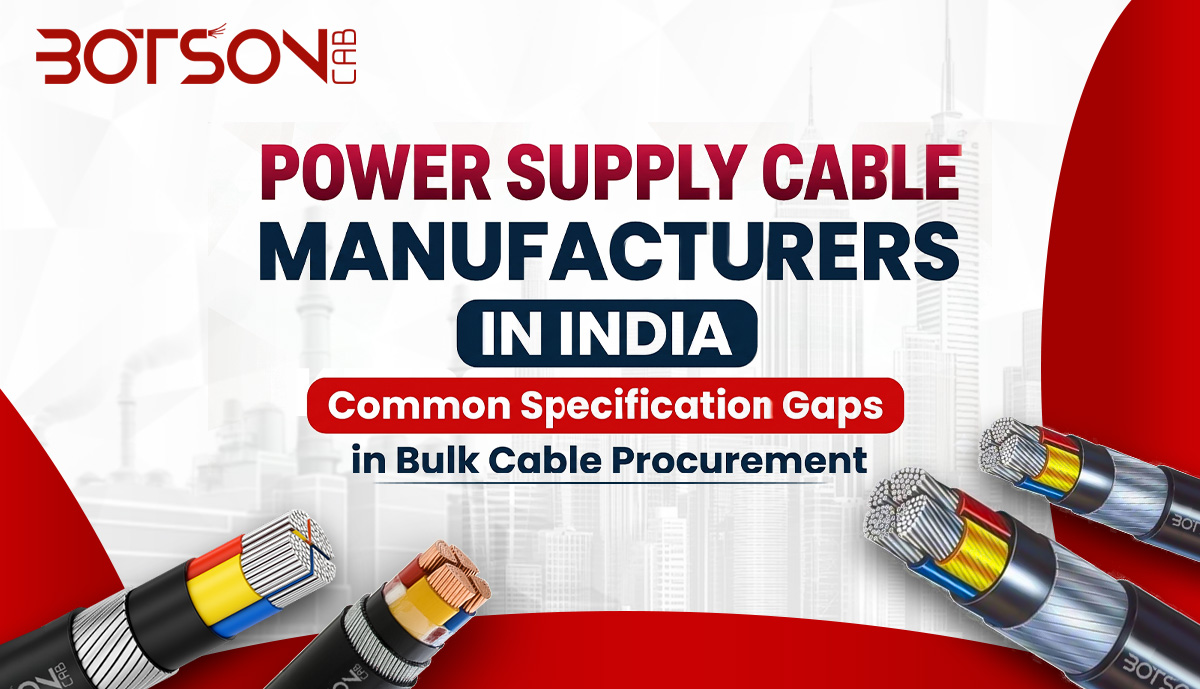
POWER SUPPLY CABLE MANUFACTURERS IN INDIA: COMMON SPECIFICATION GAPS IN BULK CABLE PROCUREMENT
Cable Technology
23-10-2026
Bulk cable procurement can go wrong before a single cable reaches the project site. A purchase order may mention the voltage rating, conductor size and total quantity, yet leave out details that affect whether the supplied cable matches the electrical design. For EPC contractors, electrical panel manufacturers, industrial buyers and cable distributors, these gaps can lead to quotation mismatches, rejected material, installation delays and unexpected costs.
When sourcing from Power Supply Cable Manufacturers in India, procurement teams need to go beyond a basic product description. The focus should be on matching the cable's complete technical specification with the project's actual requirements.
1. Specifying Voltage Rating Without Defining the Cable Standard
One common procurement gap is mentioning the voltage rating without identifying the applicable product standard and cable construction. For example, an LT power supply cable specified for a system up to 1.1 kV may still require further details about insulation, conductor type, core configuration and construction. Two quotations carrying a similar voltage description may not represent technically equivalent products.
For relevant PVC-insulated heavy-duty cables, IS 1554 (Part 1) is an important Indian standard covering cables up to and including 1,100 V. The applicable standard should always be verified against the required cable design.
What to include in the purchase specification:
- Required voltage grade.
- Applicable IS or other project-approved standard.
- Number of cores and conductor material.
- Insulation and outer sheath requirements.
- Required test documentation and acceptance criteria.
This gives manufacturers a clearer basis for quoting and helps procurement teams compare equivalent products.
2. Treating Copper and Aluminium Cables as Direct Substitutes
Copper and aluminium conductors are both used in power distribution, but they cannot be substituted simply because the cables have similar prices or nominal descriptions. Copper has higher electrical conductivity for a given cross-sectional area. Aluminium is lighter and may offer material-cost advantages, but its required conductor size, termination arrangements and installation considerations need to be evaluated.
The mistake is comparing copper and aluminium quotations without checking whether both options satisfy the same electrical design.
For bulk orders, procurement teams should confirm:
- Conductor material and specified cross-sectional area.
- Required current-carrying capacity.
- Permissible voltage drop.
- Installation conditions and applicable derating factors.
- Compatible lugs, terminals and termination methods.
The final conductor selection should follow the project's engineering requirements, not price per metre alone.
3. Ordering Cable by Square Millimetres Without Confirming Construction
A cable size such as 16 sq. mm or 120 sq. mm identifies the conductor's nominal cross-sectional area. It does not, by itself, define the complete cable.
For example, a buyer requesting a 35 sq. mm LT power supply cable must still identify whether the requirement is for a single-core or multicore cable, copper or aluminium conductor, and the specified insulation and sheath.
These details influence the product supplied and the suitability of the cable for its intended installation.
For manufacturers preparing bulk quotations, a complete specification reduces ambiguity. For buyers, it provides a more reliable basis for comparing prices and technical compliance.
Procurement tip: Use a cable schedule that records the full description of every cable item instead of listing only sizes and quantities.
4. Leaving Insulation and Sheathing Requirements Open to Interpretation
Insulation and outer sheathing serve different purposes. Insulation provides electrical separation around conductors, while the sheath protects the cable against relevant external conditions.
A specification that simply says “PVC cable” may not communicate all the required performance characteristics.
Depending on the application, the project may require PVC, HR, FR or FRLS compounds, subject to the applicable product design and standards. These designations should not be treated as interchangeable claims or assumed to guarantee every desired fire-performance characteristic.
Before placing an order, clarify:
- Required insulation and sheath materials.
- Operating temperature and environmental conditions.
- Fire-performance requirements, where applicable.
- Whether the cable will be installed indoors, outdoors, underground or in another specified environment.
- Any additional project-specific testing requirements.
This is particularly important for industrial facilities and infrastructure projects where the installation environment can vary considerably.
5. Comparing Quotations Without Checking What Is Included
A lower quotation does not necessarily represent a lower project cost. One supplier may quote against the complete required specification, while another may leave out construction details, documentation or packaging requirements.
Comparing only the quoted rate per metre can therefore produce a misleading result. When evaluating Power Supply Cable Manufacturers in India, procurement teams should compare quotations against the same technical and commercial checklist.
Procurement details What to verify
Cable specification Voltage, cores, conductor material and size
Construction Insulation, sheath and armour, if required
Compliance Applicable standards and specified tests
Quantity Total length and individual cable sizes
Packaging Drum length, identification and labelling
Delivery Dispatch schedule and delivery location
Documentation Test reports and required compliance records
A standardised comparison makes differences between quotations easier to identify before the purchase order is issued.
How Botsoncab Supports Power Supply Cable Procurement
Botsoncab manufactures wires and cables for residential, commercial, industrial and infrastructure applications. Its LT Power Supply Cable range is relevant to buyers evaluating cable requirements for low-voltage electrical distribution projects.
When approaching Botsoncab for power supply cable requirements, buyers can make the quotation process more precise by sharing their cable schedule, required specifications, quantities, applicable standards and delivery expectations.
Visit the Botsoncab LT Power Supply Cables product page to review the product information and discuss your project requirements with the company.
Conclusion
Bulk cable procurement requires more than a list of sizes and a competitive quotation. Missing construction details, unclear compliance requirements and inadequate delivery instructions can create avoidable complications throughout a project.
For businesses sourcing from Power Supply Cable Manufacturers in India, a complete cable schedule and a consistent quotation checklist provide a stronger starting point for technical evaluation and purchasing decisions. Planning a bulk cable order? Contact Botsoncab with your required specifications and quantities to discuss suitable LT Power Supply Cable options for your project.
Frequently Asked Questions
1. How can I get a bulk quotation for power supply cables from Botsoncab?
Share your required cable size, copper or aluminium conductor, voltage rating, cable construction, total quantity and delivery location to help Botsoncab assess your requirement.
2. What is the minimum order quantity for LT power supply cables?
The minimum order quantity depends on the cable specification and supply requirements. Contact Botsoncab to confirm availability and the minimum quantity for your required cable type.
3. Can I order different cable sizes in a single bulk order?
Yes, you can enquire about multiple cable sizes in one order. Provide a size-wise quantity breakdown so the manufacturer can assess the requirements for each specification.
4. What documents should I request when purchasing power supply cables for an industrial project?
Ask for the applicable standard details, technical datasheet, relevant test reports and required compliance documents. Project-specific documentation should be confirmed before placing the order.
5. How do I choose the right LT power supply cable for my project?
Share the operating voltage, expected electrical load, installation conditions, conductor preference and applicable project specifications with the manufacturer. The final cable selection should follow the project's approved electrical design.

Ready to get started?
Subscribe to our Newsletter
Stay connected with the latest trends and updates in the cables and wires industry.

Stay connected with the latest updates, innovations, and offers from BotsonCab. Join our newsletter to receive exclusive content, industry insights, and more directly to your inbox.
OFFICIAL INFO
Botsoncab , TYCON INDIA LLP D-11, Site-1, Bulandshahr Road Industrial Area, Ghaziabad, Uttar Pradesh- 201009
info@botsoncab.com
hr@botsoncab.com
+91-87961 03013
COPYRIGHTS © 2025-26 ALL RIGHTS RESERVED. POWERED BY BOTSONCAB
Developed and Maintained By Blue Brain Technologies Pvt. Ltd.