
Products

LT Power Supply Cable
LT Control Cable
LT Railway Signalling Cables
LT Submersible Cable
LT Flexible & Cord Cables
LT Multistrand Flexible Cables
LT Telephone and LAN Cables
LT Aerial Bunch Cables
LT Co-Axial Cable
LT Special Purposes Cables
Instrumental Cables
Solar Cables
All Aluminium Alloy Stranded Conductors
Aluminium Conductors Steel - Reinforced (ACSR)
Contact Form
✉ Enquiry Form

Blog &
Industry Insights
Latest updates from cable technology and electrical industry.
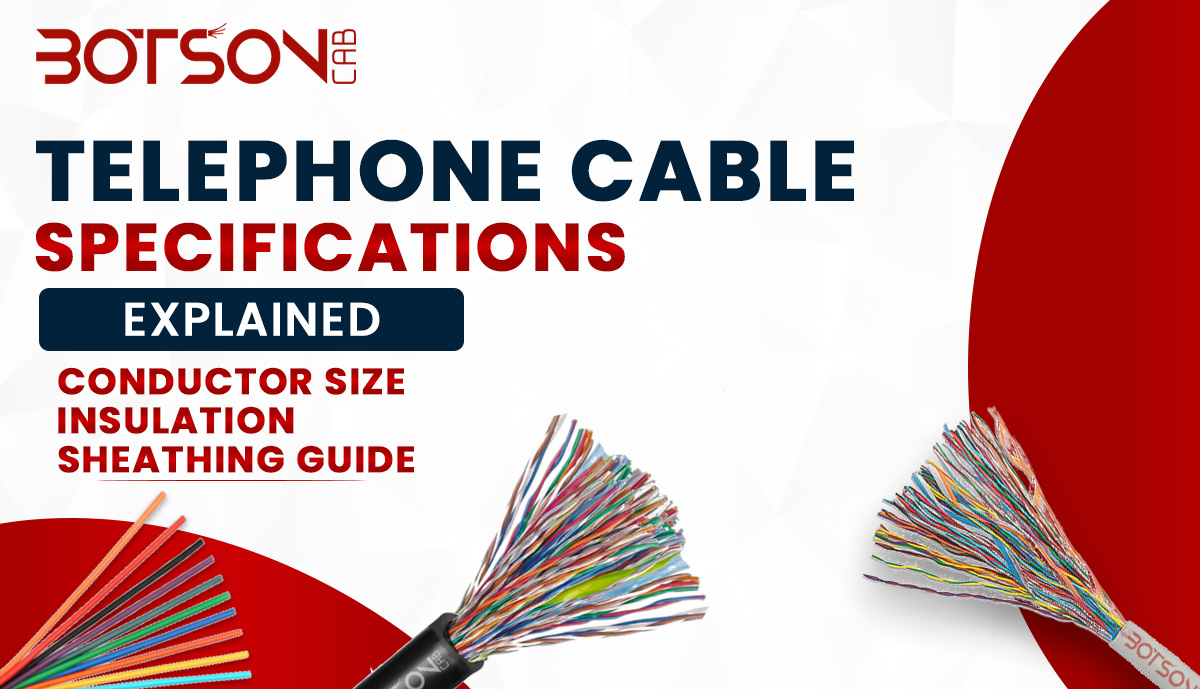
TELEPHONE CABLE SPECIFICATIONS EXPLAINED: CONDUCTOR SIZE, INSULATION & SHEATHING GUIDE
Installation Guide
12-10-2026
Choosing the appropriate telephone cable is essential in order to ensure proper communication that will be clear and reliable. The Indian company, Botsoncab, is a renowned cable manufacturer that provides cable solutions that conform to the needs of various types of communications. Though a telephone cable might seem quite simple from its outer appearance, there are many aspects that influence its performance, such as the conductor size, insulation materials, pairs of wires, and sheathing.
For businesses, contractors and infrastructure developers, understanding these specifications makes it easier to select a cable that suits the installation environment and expected service conditions. Working with experienced telephone cable manufacturers in India can also help buyers choose the appropriate construction instead of selecting a cable based only on price. This is a guide on how to understand the different telephone cable requirements in an easy way, including the conductor size and the choices of insulation and sheathing, among others.
What Is a Telephone Cable?
The telephone cable is a communication cable that transmits voice and low-voltage communication signals between connected devices or terminals. Based on their construction, the telephone cables are meant for use in residential buildings, offices, commercial buildings, communication networks, and others. Construction of a typical telephone cable entails the conductive wires covered by insulation material, which are assembled into pairs in groups covered by the outer covering.
Such construction of a typical telephone cable can be defined as:
Conductor → Insulation → Assembly → Outer covering
Different layers perform different functions. The conductor transmits the electric signals, the insulation material insulates the conductive wires, and the outer covering protects.
Why Telephone Cable Specifications Important
Each communication cabling installation is not alike in its specifications. The communication cable that is run inside the office will have totally different specifications from the one that is routed through the service area.
- Specifications include
- Transmission Quality
- Mechanical Strength
- Water Resistance
- Ease of Installation
- Service Life of Cable
- Compatibility with the system
- Maintenance
For this reason, buyers should review the technical construction before selecting LT Telephone Cables or other communication cables.
Understanding Telephone Cable Conductor Size
The conductor is one of the most crucial elements of the telephone cable. It is the electrical path that carries the communication signal. The size of the conductor is usually specified either in terms of diameter or cross-sectional dimensions.
A larger conductor may have an electrical and mechanical property that is different from that of a smaller conductor. But a larger conductor is not always the best choice; it all depends on how and where it will be used.
Common Factors When Selecting Conductor Size
Factor Why It Matters
Cable length Longer cable runs can increase transmission losses
Installation Routing conditions can influence mechanical requirements
Signal requirements Different systems have different transmission needs
Space availability Smaller cables may be easier to route in restricted spaces
Mechanical strength Conductor construction affects handling and installation
For large projects, it is advisable to confirm conductor dimensions and electrical characteristics with the manufacturer before finalizing the cable specification.
Solid and Stranded Conductors
Telephone cables may incorporate different types of conductor arrangements, depending on the purpose for which they are designed. Solid conductors are those that contain a single continuous wire made up of metal. Solid conductors are usually preferred when there will be little movement once the cable is installed. Stranded conductors are made up of small wires that have been bundled to make up a conductor. This type of arrangement may provide more flexibility in some instances. It should depend on the installation, not on the preference of one type over another.
Copper Conductors in Telephone Cables
Copper is widely used for communication cable conductors because of its electrical conductivity and established use in communication systems. The conductor material should have suitable electrical and mechanical properties for the intended application. Manufacturing quality is also important because variations in conductor dimensions, insulation or assembly can affect the finished cable. When evaluating Telephone and LAN Cables, buyers should therefore consider the complete cable construction rather than focusing only on the conductor material.
Telephone Cable Insulation
Insulation surrounds individual conductors and prevents unwanted electrical contact between them. It also contributes to the cable's overall electrical and mechanical performance. The insulation material needs to be selected according to the cable's operating environment and technical requirements.
Important insulation characteristics can include:
- Electrical resistance
- Dielectric properties
- Temperature performance
- Flexibility
- Resistance to moisture
- Compatibility with the outer sheath
- Long-term stability
Different materials can provide different combinations of these characteristics. Therefore, insulation should always be considered together with the application and applicable cable standards.
Why Insulation Quality Is Important
Poor-quality or unsuitable insulation can create problems during the service life of a cable. Damage to insulation can increase the possibility of conductor contact, signal interference or other installation issues. Good manufacturing practices help ensure that insulation is applied consistently around the conductor and remains suitable for the expected operating conditions. For this reason, reputable Telephone Cable Solutions should be selected based on technical specifications, quality controls and intended use rather than price alone.
Understanding Pairing in Telephone Cables
Many telephone cables contain pairs of insulated conductors. Pairing helps organize the conductors and supports the transmission system for which the cable is designed. The number of pairs required depends on the application. A small installation may require only a limited number of pairs, while larger communication networks can require cables containing significantly more pairs.
When choosing a cable, buyers should therefore verify:
- Number of pairs
- Conductor dimensions
- Insulation construction
- Pair identification
- Overall cable diameter
- Sheathing material
- Applicable standards
These details are normally included in the manufacturer's technical specifications.
Telephone Cable Sheathing Options
The outer sheath is the protective layer around the cable assembly. It helps protect the internal components from mechanical damage and environmental exposure.
The right sheath depends on where the cable will be installed.
Potential considerations include:
- Moisture exposure
- Temperature
- Abrasion
- Chemical exposure
- Indoor or outdoor installation
- UV exposure
- Installation method
- Fire and safety requirements
The sheath should be sufficiently robust for the expected installation conditions while remaining practical to handle and install.
Why Manufacturer Selection Matters
The quality of a finished cable depends on much more than its raw materials. Conductor consistency, insulation application, pair assembly, dimensional control and testing all contribute to the final product.
A reliable manufacturer should be able to provide clear technical information about:
- Cable construction
- Conductor specifications
- Insulation material
- Sheathing material
- Available configurations
- Applicable standards
- Testing and quality procedures
This information allows buyers to compare products on technical merit instead of relying only on cost.
Choosing Telephone Cable Manufacturers in India
India has a broad manufacturing base for electrical and communication cables. When comparing suppliers, buyers should consider manufacturing capability, product range, quality systems, technical support and the manufacturer's ability to meet project requirements. Botsoncab provides cable and wire solutions for different electrical and communication applications. Buyers looking for Telephone cable manufacturers in India can review Botson'cabs LT Telephone and LAN Cables range and discuss their specific cable requirements with the company.
For customers evaluating broader Electrical Wires and Cables, reviewing the manufacturer's product portfolio can also help identify suitable solutions for related applications.
Telephone Cables vs LAN Cables
Telephone and LAN cables are both used for communication, but they are not necessarily interchangeable.
Telephone cables are designed around the requirements of telephone and related communication systems, while LAN cables are generally designed for computer networking and data transmission. The appropriate cable should therefore be selected according to the equipment, transmission requirements and applicable system specifications. Businesses with multiple communication requirements can review Telephone and LAN Cables to understand available product options.
Quality Checks That Buyers Should Consider
Before purchasing a communication cable, buyers should ask for relevant technical documentation and verify the product specifications.
Useful checks include:
- Conductor dimensions
- Conductor material
- Insulation characteristics
- Number of pairs
- Cable diameter
- Sheath construction
- Applicable standards
- Routine testing requirements
- Packaging and identification
For project-based procurement, these details can make the purchasing process more transparent and reduce the risk of receiving a cable that does not match the original specification.
Conclusion
Telephone cable performance depends on the complete cable construction rather than one specification alone. Conductor size determines important electrical and mechanical characteristics, insulation protects individual conductors, while the outer sheath provides protection against the conditions encountered during installation and service. Before selecting a cable, buyers should consider the application, cable length, number of pairs, conductor construction, insulation, environmental conditions and applicable standards.
For businesses looking for Telephone cable manufacturers in India, Botsoncab can be considered as a manufacturer for communication and cable requirements. Explore Reliable Communication Cables and contact the manufacturer to discuss the specifications required for your project.
Frequently Asked Questions
1. For what purpose is a telephone cable intended?
For transmitting voice and other low voltage communication signals from one device or network point to another. The specific use of the cable depends on its design and communication system.
2. What conductor size is required for a telephone cable?
The required conductor size depends on the cable design, application, cable length, installation conditions and technical requirements. It is better to choose the size of the conductor in accordance with the manufacturer's data and not only by its diameter.
3. What is the role of insulation in a telephone cable?
Insulation isolates individual conductors and prevents electric contact. In addition, it affects the cable electrical characteristics and protects the conductor during installation and operation.
4. How do I choose a telephone cable manufacturer in India?
The choice of the manufacturer of a cable is carried out considering product parameters, production capacity, quality assurance system, testing procedures, standards and technical support of the manufacturer. Also, the manufacturer must provide technical information regarding the chosen cable.
5. Are telephone cables interchangeable with LAN cables?
No, generally speaking. Telephone and LAN cables are designed for different communication needs. The right cable must be selected

Ready to get started?
Subscribe to our Newsletter
Stay connected with the latest trends and updates in the cables and wires industry.

Stay connected with the latest updates, innovations, and offers from BotsonCab. Join our newsletter to receive exclusive content, industry insights, and more directly to your inbox.
OFFICIAL INFO
Botsoncab , TYCON INDIA LLP D-11, Site-1, Bulandshahr Road Industrial Area, Ghaziabad, Uttar Pradesh- 201009
info@botsoncab.com
hr@botsoncab.com
+91-87961 03013
COPYRIGHTS © 2025-26 ALL RIGHTS RESERVED. POWERED BY BOTSONCAB
Developed and Maintained By Blue Brain Technologies Pvt. Ltd.