
Products

LT Power Supply Cable
LT Control Cable
LT Railway Signalling Cables
LT Submersible Cable
LT Flexible & Cord Cables
LT Multistrand Flexible Cables
LT Telephone and LAN Cables
LT Aerial Bunch Cables
LT Co-Axial Cable
LT Special Purposes Cables
Instrumental Cables
Solar Cables
All Aluminium Alloy Stranded Conductors
Aluminium Conductors Steel - Reinforced (ACSR)
Contact Form
✉ Enquiry Form

Blog &
Industry Insights
Latest updates from cable technology and electrical industry.
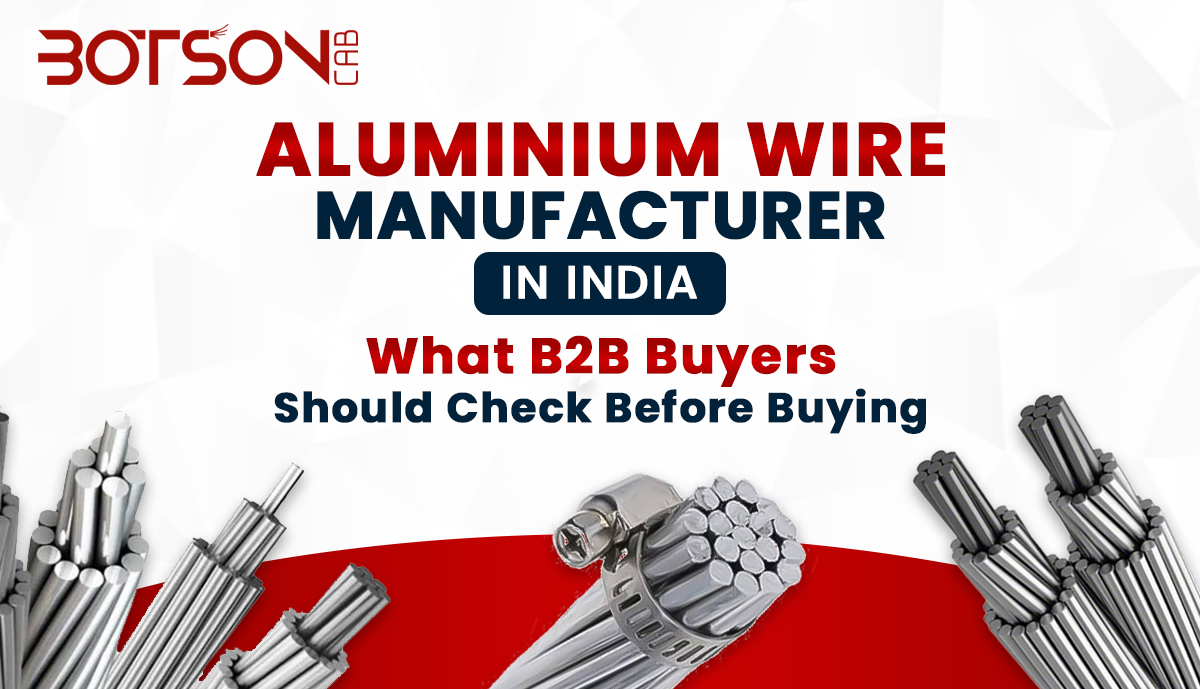
HOW TO CHOOSE A RELIABLE ALUMINIUM WIRE MANUFACTURER IN INDIA — A B2B BUYER’S CHECKLIST
Electrical Safety
07-09-2026
Buying aluminium wire for a commercial or industrial requirement is not simply a matter of comparing prices per kilogram. For B2B buyers, the manufacturer you choose can affect electrical performance, production consistency, installation reliability, material wastage and the long-term cost of a project.
This becomes especially important when ordering aluminium wire in bulk. A quotation may look competitive, but if the conductor quality, dimensions, mechanical properties or manufacturing consistency are not right, the apparent saving can quickly disappear.
If you are evaluating aluminium wire manufacturers in India, use the following checklist before finalising a supplier.
1. Start With the Actual Application
The right aluminium wire depends on where and how it will be used.
Before approaching a manufacturer, define:
- Required wire diameter or cross-sectional area
- Electrical application
- Required conductivity
- Mechanical requirements
- Required quantity
- Coil or packing requirements
- Applicable specifications or standards
- Whether the requirement is recurring or one-time
A manufacturer should be able to understand these requirements rather than simply quote a standard product.
For B2B procurement, this initial technical discussion is often more valuable than getting the lowest quotation first.
2. Ask What Aluminium Grade and Raw Material Are Being Used
The quality of finished aluminium wire starts with its raw material.
Ask the manufacturer about the aluminium grade, raw-material specifications and incoming material inspection process. The manufacturer should be able to explain how the material is selected and controlled before it enters production.
This matters because the conductor's electrical and mechanical behaviour depends heavily on its material composition and manufacturing process.
A serious manufacturer should not treat raw material as an afterthought.
Buyer Check
Ask for:
- Raw-material specification
- Applicable material standard
- Incoming inspection procedure
- Traceability, where applicable
- Relevant material/test documentation
3. Don't Judge Quality by Appearance Alone
A clean, bright-looking wire does not automatically mean it is a technically reliable product.
For electrical applications, buyers should look at measurable characteristics such as:
- Electrical resistance or conductivity
- Diameter and dimensional consistency
- Tensile strength
- Elongation
- Surface condition
- Weight and length consistency
- Manufacturing tolerances
These parameters give you something much more useful than visual inspection: objective evidence of product quality.
4. Check How the Manufacturer Controls Wire Diameter
Dimensional consistency becomes important when aluminium wire is processed further, used in winding, stranding, cabling or other manufacturing operations.
A small variation may not seem significant on an individual coil, but repeated dimensional inconsistency can create problems during downstream processing.
Ask the manufacturer:
“How is wire diameter measured and controlled during production?”
Look for manufacturers that have defined inspection procedures and suitable measuring equipment rather than relying only on final visual inspection.
5. Ask About Electrical Testing
For electrical-grade aluminium wire, conductivity and resistance are critical purchasing parameters.
Don't simply accept the statement that the wire is “high conductivity.” Ask how the manufacturer verifies it.
Depending on the product specification, relevant testing may include:
- Electrical resistance/conductivity
- Tensile strength
- Elongation
- Dimensional checks
- Surface inspection
- Other tests required by the applicable specification
A reliable manufacturer should be able to explain what is tested, when it is tested and how the results are recorded.
6. Verify the Applicable Standard — Not Just a Certificate
One of the most common B2B procurement mistakes is asking only, “Is the product certified?”
A better question is:
“Which standard applies to this exact product and specification?”
The applicable Indian Standard, IEC specification or customer specification can vary according to the type and intended application of the aluminium wire.
Ask the manufacturer to identify the relevant standard and provide supporting documentation where applicable.
Also check whether the actual product being supplied matches the specification mentioned in the quotation and technical documents.
7. Evaluate Manufacturing Capability Before Placing a Large Order
A manufacturer may be able to supply a small trial quantity but struggle when the order volume increases.
For bulk procurement, evaluate:
- Production capacity
- Drawing equipment
- Quality-control facilities
- Inspection process
- Storage and handling
- Packaging capability
- Lead times
- Batch consistency
This is particularly important for OEMs, electrical manufacturers, contractors and distributors that depend on repeat supply.
8. Request a Sample Before the Full Purchase
For a new supplier, a sample or trial batch can reduce procurement risk.
Don't evaluate the sample only by appearance. Compare it against the technical requirements you have defined.
Where practical, evaluate:
Specification → Dimensions → Electrical properties → Mechanical properties → Surface condition → Packaging → Documentation
For recurring B2B purchases, keeping an approved sample or documented specification as a reference can also make future quality checks easier.
9. Compare Total Procurement Cost, Not Just the Quoted Rate
Suppose Supplier A quotes a lower price but has inconsistent dimensions, higher material wastage or longer lead times.
Supplier B costs slightly more but provides consistent material, proper documentation and dependable delivery.
The lower quotation may not actually be the lower-cost option.
For B2B buyers, evaluate:
Material price + testing + wastage + rejection risk + freight + delivery reliability + downstream processing cost
This is the total procurement cost, and it gives a much more realistic comparison between aluminium wire manufacturers.
Aluminium Wire Manufacturer Checklist for B2B Buyers
Before approving a manufacturer, verify these points:
Buyer Check
What to Verify
Raw material Grade and material specification
Product Exact wire size and application
Electrical quality Resistance/conductivity requirements
Mechanical properties Tensile strength and elongation where applicable
Dimensions Diameter and permissible tolerance
Testing In-process and final inspection
Standards Applicable IS/IEC/customer specification
Documentation Test reports and relevant quality records
Production Capacity and batch consistency
Sample Trial approval before bulk purchase
Delivery Lead time and supply capability
Support Technical and post-order communication
Why Botsoncab Can Be Considered for Aluminium Wire Requirements
For B2B buyers, choosing a manufacturer should ultimately come down to technical capability, manufacturing control, product consistency and the ability to meet the specified requirement. Botsoncab focuses on the manufacturing and supply of wires and cables for electrical and industrial requirements. When evaluating Botsoncab or any other aluminium wire manufacturer, buyers should discuss their required specification, application, quantity, testing requirements and delivery schedule before finalising the order.
The objective should be simple: select a manufacturer that can consistently supply the right aluminium wire to the required specification, rather than choosing purely on the lowest quoted price.
Conclusion
Choosing reliable aluminium wire manufacturers in India requires a technical and commercial evaluation—not just a price comparison.
Check the raw material. Confirm the applicable standard. Review electrical and mechanical properties. Examine dimensional consistency. Ask about testing and documentation. Start with a sample where appropriate, and assess whether the manufacturer can maintain the same quality across repeat batches.
For B2B procurement, the best supplier is rarely defined by the cheapest quotation. It is the manufacturer that can provide consistent material, controlled production, verifiable quality and dependable supply against your actual specification.
That is the checklist worth using before you approve your next aluminium wire supplier.
Ready to Source Aluminium Wire With Confidence?
Share your requirements today and let’s discuss the right solution for your application.
FAQS
1. What documents should I request from an aluminium wire manufacturer before approving a bulk order?
Before approving a bulk order, ask for the product technical specification, applicable standard, relevant test report, material details and batch/lot identification, as applicable to the product. For repeat procurement, also confirm whether the manufacturer can provide consistent documentation with subsequent batches.
2. How can I compare two aluminium wire manufacturers when both quote the same wire size?
Don't compare the quoted rate alone. Put both suppliers against the same aluminium grade, conductivity/resistance requirement, diameter tolerance, tensile properties, applicable standard, testing scope, packing, quantity and delivery terms. A manufacturer offering the same nominal size may still differ considerably in manufacturing controls and product consistency.
3. What aluminium wire quality parameters should a B2B buyer mention in the purchase specification?
A purchase specification should clearly define the wire size, applicable material/product standard, electrical requirement, mechanical properties where applicable, dimensional tolerance, surface condition, quantity, packing and inspection/testing requirements. Clearly defining these parameters prevents a supplier from interpreting a basic requirement differently from your actual production need.
4. How do I check whether an aluminium wire manufacturer can handle my recurring monthly requirement?
Ask the manufacturer about available production capacity, current lead times, minimum order quantities, batch planning, storage/dispatch capability and repeat-order controls. More importantly, establish whether your approved specification will remain unchanged across future batches and how deviations are handled.
5. What should I do if an aluminium wire sample passes inspection but the bulk batch does not?
First compare the bulk material against the approved sample and agreed technical specification. Check the batch identification, dimensional measurements, electrical and mechanical test results, and inspection records. A proper supplier evaluation should include a defined process for investigating non-conforming material rather than relying solely on visual replacement or verbal assurances.
You May Also Like - Industrial Cables Manufacturers in India: What Really Defines Cable Quality, Performance and Reliability?

Ready to get started?
Subscribe to our Newsletter
Stay connected with the latest trends and updates in the cables and wires industry.

Stay connected with the latest updates, innovations, and offers from BotsonCab. Join our newsletter to receive exclusive content, industry insights, and more directly to your inbox.
OFFICIAL INFO
Botsoncab , TYCON INDIA LLP D-11, Site-1, Bulandshahr Road Industrial Area, Ghaziabad, Uttar Pradesh- 201009
info@botsoncab.com
hr@botsoncab.com
+91-87961 03013
COPYRIGHTS © 2025-26 ALL RIGHTS RESERVED. POWERED BY BOTSONCAB
Developed and Maintained By Blue Brain Technologies Pvt. Ltd.